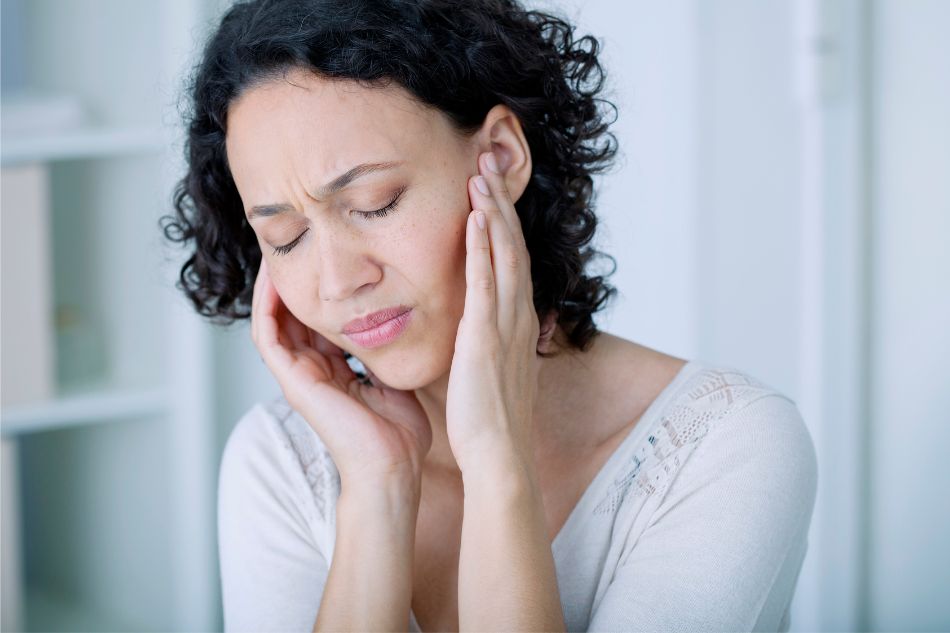
Jaw popping or clicking is often considered to be harmless when it happens without pain. Your dentist may have told you to ignore it if it is painless. However, if it progresses to intermittent locking, catching, limited movement, or joint pain, especially along with neck tension, facial pain, headaches, bite changes, or difficulty opening, that progression can signal that the TMJ and surrounding head-and-neck system deserve an expert examination.
At our Kansas City TMJ and sleep practice, we provide comprehensive neuromuscular dental care to understand how the TMJs, bite, facial muscles, and neck muscles work together. Dr. Prabu Raman looks beyond the sound itself to identify the structural and physiological factors that may be contributing to the problem.
Understanding the Mechanics Behind the Noise
The temporomandibular joints, or TMJs, connect the lower jaw to the skull and work closely with the muscles of the face and neck. Inside each joint is a small cushioning disc that helps the joint move smoothly as you open, close, speak, and chew.
Sometimes the disc sits farther forward than its optimal position when the mouth is closed because the tiny ligaments that hold the disc in place have been stretched or partially torn. As the lower jaw and neck system moves during opening, the slack in the ligament is used up, and the disc snaps into an optimal relationship within the joint, creating a click or pop. But it slips out of place quietly as the mouth is closed again.
An occasional painless sound does not automatically mean you need treatment. It becomes more of a concern when clicking becomes frequent, painful, or associated with catching, locking, limited opening, neck pain, or changes in the bite.
Our approach to TMJ treatment in Kansas City focuses on identifying the source of the dysfunction before deciding whether treatment is indicated.
The Dental Side of TMJ Dysfunction
TMJ problems can affect more than joint comfort. When the jaw-and-neck relationship is not functioning comfortably, the facial and neck muscles may work harder to guide movement and bring the teeth together.
Clenching can increase the load on the TMJs, upper cervical joints, muscles, and teeth. Grinding can also leave visible wear on the teeth. Over time, some patients notice worn, chipped, or cracked teeth; changes in how the teeth meet; facial fatigue; or soreness in the jaw and neck muscles.
These signs do not prove that the one bite problem caused every symptom. Instead, they give us information about how the teeth, muscles, TMJs, and neck may not be functioning together optimally.
Why the TMJ and Neck Can Lose Their Comfortable Relationship
Several factors can change how the TMJs, facial muscles, and neck muscles function. A single cause is not always responsible, but an accumulation of many factors may be. That is why we evaluate the overall pattern rather than treating a single click.
Possible contributors can include:
- A previous injury or trauma
- Nighttime or daytime clenching
- Postural compensation through the head, shoulders, and upper cervical area
- Muscle imbalance or fatigue
- Stress-related muscle tension
- Structural deficiencies in the joints or surrounding anatomy
- Bite relationships
Poor function can create a cycle. An uncomfortable lower-jaw-and-neck relationship may cause muscles to work harder, increasing tension and nerve input. In turn, that added tension may make movement feel less natural.
How Dr. Raman Measures a Physiological Resting Position
Our first visit focuses on conversation and a clinical evaluation. We do not begin with scans. Dr. Prabu Raman reviews your symptoms, function, history, and the relationship between the TMJs, facial muscles, bite, and neck.
If you choose to proceed with detailed diagnostics, we may use the data-driven Cranio-Cervical-Mandibular Dysfunction (CCMD) protocol. The Myotronics K-7 Evaluation System measures muscle activity and tracks lower-jaw movement, while Cone Beam Computed Tomography (CBCT) imaging provides structural information. We can also use digital scanning to analyze how the teeth currently meet.
During this process, we relax the jaw, facial, and neck muscles and compare your presenting bite with a precisely diagnosed physiological resting position. The goal is to understand the structural and physiological causes before discussing treatment options.
Protecting Your Jaw and Neck Health
A click by itself does not mean permanent damage is occurring. Still, changing or uncomfortable symptoms deserve attention because they can reveal a larger functional problem involving the TMJs, bite, facial muscles, and neck.
Consider an evaluation if you notice:
- Pain with clicking or popping
- Catching or locking
- Reduced ability to open comfortably
- A change in how your teeth meet
- Neck pain, facial pain, or recurring headaches
- Increasing muscle fatigue
- Visible tooth wear, chips, or cracks
Treatment depends on what the evaluation and diagnostic tests reveal. When significant tooth wear or a long-term bite problem requires correction, care may eventually include Neuromuscular Full-Mouth Reconstruction or Neuromuscular Functional Orthodontics, as indicated. We do not assume every patient with jaw popping needs either approach.
Frequently Asked Questions About TMJ Symptoms
TMJ symptoms can overlap with ear, head, tooth, facial, and neck concerns. These answers explain several common patterns, but an expert TMD evaluation is the best way to determine what is relevant in your case.
Schedule a TMJ Evaluation in Kansas City
If popping or clicking comes with neck tension, facial pain, headaches, locking, bite changes, or tooth wear, we can help you understand what may be contributing to the problem. Our TMD evaluation focuses on the relationship among the TMJs, muscles, teeth, bite, and neck rather than the noise alone.
Click the button below or call us at (816) 436-4422 to schedule an evaluation at Raman Center for TMJ & Sleep in Kansas City.